Is Continuous Innovation Possible for All?
AI has unleashed continious customer-centric innovation, but it still may be the luxury of large enterprises.

Teresa Torres in her 2021 book, “Continuous Discovery Habits” outlined frameworks for conducting weekly customer interviews. COVID accelerated the digitization of research, and with the growing shift toward AI automation, continuous discovery has become the new standard for digital products serving large user bases.
Now, small and medium enterprises and nonprofits can embrace continuous discovery in their digital communications with stakeholders. The real question is whether they can embrace AI well enough to do so.
We’re not talking about ChatGPT or your LLM of choice, though they can play a role in processing natural language interviews and sentiment analysis. Once again, achieving a promise requires a deeper operationalized focus on AI adoption. Conducting successful continuous innovation requires strong business transformation and data governance initiatives to better map customer, member, and donor journeys, a deep contextual understanding of key customer touchpoints, and talent resources.
That’s in addition to upskilling teams who are willing to embrace constant improvement as their work ethos. While in theory, consistent evolution is now the name of the game, much of the workforce is not used to such efforts. Abandoning quarterly and even annual reviews requires upskilling in both technology and process management.
Why Striving Toward Continuous Improvement Matters
There is a good reason for the success of continuous discovery. Incorporating the ability to deploy experimental A/B (/C/D) testing of new digital features and approaches is a powerful capability. Deploying on consistent touchpoints with proper governance and research practices can dramatically impact a brand’s ability to serve its stakeholders.
Companies that shipped digital features with 35% higher adoption rates than those using quarterly research cycles, while companies running 1,000+ experiments annually show 30-50% higher innovation success rates (Kohavi, Tang, and Xu). This is best typified by Microsoft, Spotify, Netflix, and other major technology companies, as discussed in Torres’ book.
Forrester has since validated the impact AI has made on the continuous improvement innovation cycle. Automated sentiment and theme identification in customer interviews and online postings reduced analysis time by 60-80%.
Why It May Be Harder for SMEs
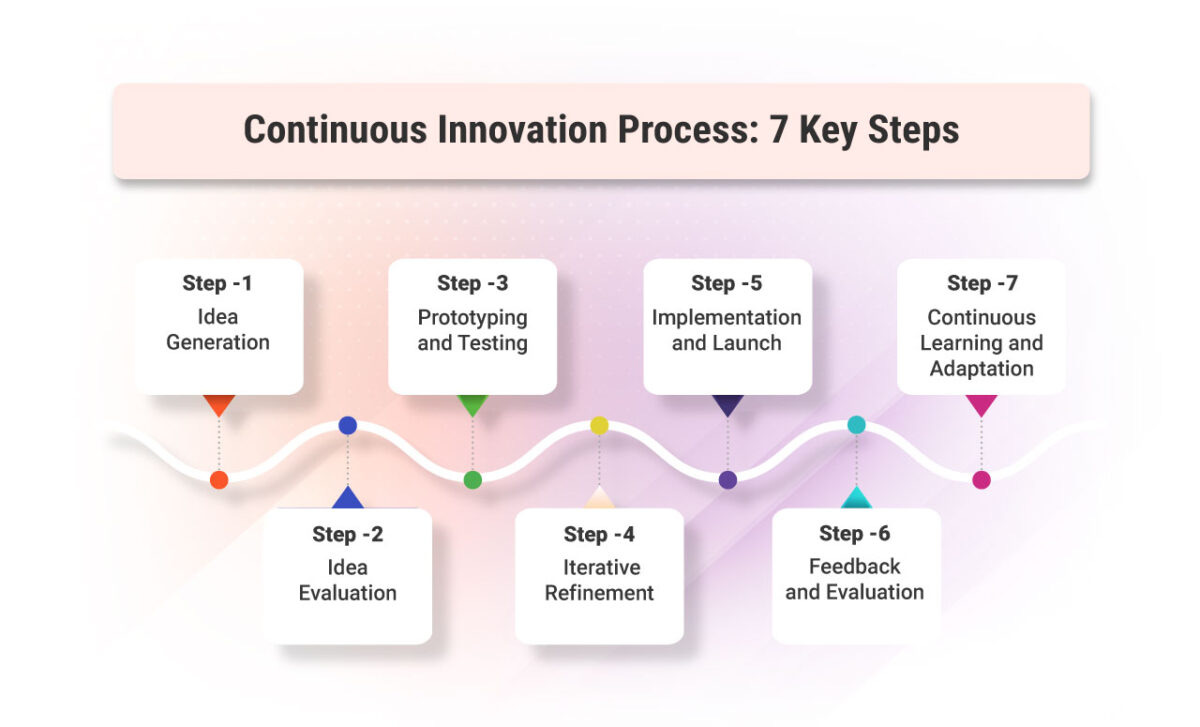
The above chart illustrates a continuous innovation process. Let’s examine some of the business components of continuous improvement, and how they impact small and medium enterprises and nonprofits in a broad small and medium business (SMB) category, <$1 billion and <$50 million, respectively. Here are some of the common elements of an enterprise with a well-implemented ongoing innovation cycle:
Weekly Touchpoints: At least 2-3 hours per week of structured customer conversations with immediate findings shared.
Discovery Backlogs: Product delivery backlog is populated with assumptions as they develop to test and opportunities to explore.
Opportunity Solution Trees: Visual mapping connecting business outcomes → opportunities → solutions for evaluation by human teams.
Assumption Testing: Rapid validation of riskiest assumptions through. interviews, prototypes, and data analysis before heavy engineering investment
Experimentation: Infrastructure enabling concurrent A/B tests of innovations with automatic statistical analysis (could be in the thousands). Include testing rigor to ensure accurate validation.
Dual-Track Agile Development: Explore customer problems one sprint ahead of delivery, then build and ship validated solutions.
As you can see, this approach to customer interactions and digital product or service implementation requires a significant and mature technology development organization. Having worked in a few startups, it’s not impossible for an SMB to implement these practices, particularly with today’s low-code AI tools.
However, outside of tech start-ups, implementation requires a significant evolution of operations and business processes well beyond simple tech acquisitions. Complicating matters may be skillsets and simple bandwidth. Smaller organizations may lack the technical and time capacity for weekly research cadences.
Don’t take the skillset issue lightly. One of the biggest dangers of AI-fueled continuous improvement is simply accepting the AI’s results or implementing them with minimal or weak governance practices. AI slop delivered due to lack of context, immature algorithms, bias, poor training, etc., can lead an organization into wayward technical selections.
Upskilling team members to serve as the critical human in the loop and implementing strong governance allows organizations to better manage core processes. In fact, this is one of those AI initiatives that when organizations fail to bring in the talent or upskilling, they either suffer reduced project outcomes or experience significant failures.
For example, weak or superficial customer/member/beneficiary interviews will lack context to inform the process. Great volumes of data do not necessarily translate into strong analyses or actions. Models can have biases towards large consumer customer bases and tech systems, which can slow or even harm a B2B, nonprofit, or consumer SMB’s approach to improvements.
Capabilities Evolution and Next Steps
While moving from traditional service models to continuous improvement may seem like a monolithic task for SMBs, the right approach is moving towards an ideal state one step at a time. That may mean adapting monthly or bi-weekly product or service improvement touchpoints instead of monthly. Here’s what that might look like:
Adapt continuous discovery to account for a smaller customer base: monthly deep dives with quarterly touchpoints
Emphasize qualitative depth over quantitative scale: What is the most impactful evolution or change we can make?
Map distinct jobs for job executor, manager, and support team roles: Write service improvement and delivery into job descriptions.
Use Salesforce/CRM integration to trigger automated customer feedback requests at key journey moments
For Nonprofits (Member or Beneficiary Focus) that might further evolve to:
Balance continuous feedback with member or beneficiary burden (surveys can create fatigue in vulnerable populations)
Integrate member/beneficiary input into member/beneficiary service program design through co-creation workshops
Use mobile-first feedback mechanisms for accessibility wherever possible. Email is an aging outreach tool.
Measure outcome achievement (impact), not just satisfaction. Are we on mission?
Of course, strategy requires work to be successful. That means systematic skill and business process improvement are required. It may require upskilling existing staff for the mission, hiring external consultants or firms (COOs writhe while reading this), and/or new hires.
In addition to ensuring capable talent to implement and manage, there are core technical capabilities that support the continuous improvement cycle. It may be that current systems are capable of supporting continuous improvement with a few upgrades or simply by using existing features. Or, it may require new acquisitions over time.
Upgrading and adding software tools that can help support real or near real-time business processes include capabilities such as:
Natural Language Processing: Analyze thousands of support tickets, reviews, and social mentions for sentiment and themes in real-time
Predictive Churn Models: Identify at-risk customers based on behavioral signals (declining usage, increased support contacts, negative sentiment)
Automated Closed-Loop: Trigger personalized interventions when metrics indicate risk
Voice and Text Analysis: VoC programs incorporating voice/text analysis alongside surveys (see this Gartner report)
What This Really Means for Business Leaders

Continuous innovation is becoming more accessible, but it’s far from a plug-and-play, quick-fix technology purchase. While AI has lowered some technical barriers, the real work—building the operational discipline and cultural capabilities—remains the same challenge it’s always been.
Still, business and nonprofit leaders should be encouraged. You can absolutely implement meaningful continuous improvement cycles with a strategic approach grounded in realism about how to scale up. It’s about taking a systematic approach to building the right foundations.
Organizations that combine accessible AI tools with solid governance and process discipline can achieve significant improvements without massive infrastructure investments. The key is starting where you are, not where the enterprise playbooks suggest you should be.
Start where you are and modify to match what your team is capable of in the short term. For example, monthly touchpoints instead of weekly ones, qualitative depth over quantitative scale, and building human oversight capabilities alongside AI deployment.
The curious-minded approach here is to view continuous improvement as an evolving capability rather than a destination. Start with what’s manageable, learn from what works, and gradually increase sophistication as your organizational muscles develop.
Have you experimented with any form of structured customer feedback or improvement cycles in your organization? What worked well, and where did you hit roadblocks?
Fantastic read thank you!